
Bags that become part of the language of fashion itself. The Louis Vuitton Neverfull is one of those bags.
Introduced in 2007, it was designed around a simple idea. A tote that could carry a great deal without feeling cumbersome. Nearly two decades later, that idea still makes sense. But in 2026, with prices for new designer handbags continuing to rise and the preloved market offering an enormous choice of older pieces, is a Neverfull still worth buying?
We think the answer is yes.
There are handbags that belong to a particular fashion moment. Then there are handbags But perhaps not for the reason you might expect. The Neverfull is worth considering because it combines recognisable design, practical construction, versatility and enduring demand. It is also one of those handbags where buying preloved can make particular sense because the style has existed for long enough for buyers to choose from different ages, conditions, materials and sizes. The important part is knowing what you are buying. And that is where Know the Mark comes in.
The Neverfull Is More Than a Big Tote
The name gives away the original concept. The Neverfull was created to be spacious. But calling it simply a large tote misses what has made the design endure. The silhouette is uncomplicated. The sides can be adjusted with its laces, allowing the shape to become more structured or more relaxed. The handles allow it to sit comfortably on the shoulder or arm. The removable pouch provides another practical element.
Louis Vuitton currently describes the Neverfull PM as a compact tote measuring 29 × 21 × 12 cm. The brand lists the PM as capable of accommodating items such as a nine inch tablet, smartphone, wallet, sunglasses, keys and other everyday essentials.
The MM is considerably larger at 47 × 28 × 14 cm and is designed to accommodate larger everyday essentials, including a laptop.
That difference is important. Because when people talk about the Neverfull, they often picture the MM. But bigger does not automatically mean better.
Neverfull PM or Neverfull MM?

This is really a question of how you live.
The Neverfull PM
The PM is the more compact interpretation of the Neverfull. It retains the recognisable shape and design language without asking you to carry a large tote. Louis Vuitton lists the PM at 29 × 21 × 12 cm. It is particularly appealing if your everyday essentials are relatively compact and you want a handbag that feels more refined and manageable. Think phone, wallet, keys, sunglasses, cosmetics and the things you actually reach for throughout the day. The PM also makes an interesting choice for someone who loves the Neverfull but does not need the capacity associated with the larger sizes.
The Neverfull MM
The MM is the more generous everyday option. At 47 × 28 × 14 cm, it offers substantially more room and is particularly suited to work, commuting, travel and days when your handbag somehow becomes responsible for transporting half your life.
The MM is practical.
The PM is practical too.
They simply serve different lifestyles. And this is why we would never tell every buyer that one size is automatically the right choice. The right Neverfull is the one that fits your life.
But What About the Neverfull Kabuki?
This is where things become particularly interesting. Not every Neverfull is intended to be the everyday Monogram tote you see everywhere.
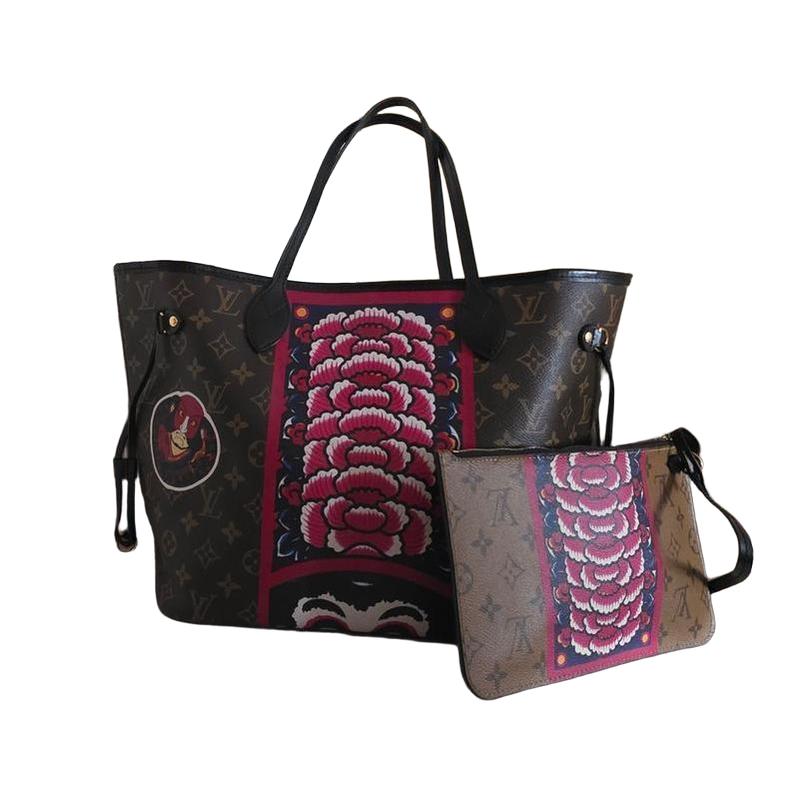
The Louis Vuitton Kabuki collection brought an artistic interpretation to the familiar Neverfull silhouette. For the collector or fashion enthusiast, that distinction matters. A more unusual Neverfull can offer something beyond practicality. It can become a conversation piece, an expression of personal taste and a piece of Louis Vuitton design history. That is why a piece such as a Neverfull Kabuki MM deserves to be considered differently from a classic Monogram Neverfull. You are still buying the recognisable Neverfull form. But you are also buying a more distinctive interpretation of it.
For someone who already owns several classic handbags, or simply wants something that feels less expected, that can be a compelling reason to choose a special edition. And this is exactly why we believe the preloved market is so fascinating. It allows you to discover versions of familiar designs that you may not encounter in the current collection.
Is Buying a Neverfull Preloved Worth It?
This is where we would say yes with a little more confidence. Buying preloved gives you the opportunity to look beyond what is currently sitting on a boutique shelf.
You can consider older versions.
Special editions.
Discontinued colourways.
Different materials.
Different eras.
And pieces that have already developed the character that comes with being worn and loved. But there is an important condition. You have to know what you are looking at. A lower price does not automatically make a handbag a good purchase. The bag needs to be authentic. The condition needs to be accurately represented. The price needs to make sense for that condition. And the seller needs to be transparent about what you are actually buying. That is especially important with a globally recognisable handbag such as the Neverfull.
Authentication Comes Before Everything
This is where we return to our favourite DaSegna principle.
Know the Mark.
When assessing a preloved Louis Vuitton, there is no single detail that should be treated as the entire authentication process.
A date code alone does not authenticate a bag. A heat stamp alone does not authenticate a bag. A dust bag does not authenticate a bag. A receipt does not authenticate a bag. Authentication is about the complete picture. Construction. Materials. Canvas. Stitching. Hardware. Heat stamps. Interior details. Production characteristics. And, depending on the age of the piece, the identification system used by Louis Vuitton during that period. That last point is particularly important because authentication has evolved alongside Louis Vuitton's production and identification practices.
This is why we believe authentication should be approached as a process rather than a checklist.
What Makes a Neverfull Worth Buying?
For us, there are several questions worth asking.
Is it authentic?
Always the first question.
Is the condition appropriate?
A preloved handbag does not need to look untouched.
Patina, gentle signs of wear and evidence that a bag has been used can be part of its character.
What matters is understanding exactly what you are buying.
Is the price appropriate for the condition?
A beautifully preserved peice should not be evaluated in exactly the same way as a heavily worn peice.
Condition changes the conversation.
Is it the right size for you?
There is no prize for owning the largest handbag.
If you only carry a few essentials, a PM may make much more sense than an MM.
If you work with a laptop or travel frequently, the MM may be the better choice.
Do you actually love it?
This question is often overlooked.
A handbag should not become a spreadsheet exercise.
If you love the silhouette, will use it frequently and understand what you are buying, you are already approaching the purchase from a much healthier perspective.
Is a Neverfull an Investment?
We would be careful with that word.
There is a difference between buying a handbag that has demonstrated enduring resale demand and buying a handbag because you expect it to generate a financial return. Those are not the same thing. The Neverfull has established itself as an enduring Louis Vuitton design, and its recognisability contributes to its continued presence in the secondary market. But no handbag comes with a guaranteed future resale price.
Condition changes.
Fashion changes.
Consumer preferences change.
Markets change.
And what you paid for the bag matters.
So rather than asking: Will my Neverfull make me money?
We think there is a better question. Will I enjoy owning this bag enough that its resale potential becomes a bonus rather than the reason I bought it? That is a much more sensible way to approach designer fashion.
Why Condition Matters So Much
One of the great things about buying a preloved Neverfull is that you can see how the materials have aged.
The coated canvas can remain remarkably recognisable over time.
Natural leather develops patina.
Hardware can show signs of use.
The interior can tell you how a bag was actually lived with.
None of these things should automatically make a bag undesirable.
But they should be understood. A darker natural leather handle, for example, is not automatically a defect.
On the other hand, significant cracking, structural damage, severe staining or compromised stitching deserve much closer attention.
The difference is knowledge. You need to know what represents normal ageing and what represents a genuine condition concern.
Why 2026 Is a Particularly Interesting Time to Buy Preloved
The designer handbag market has changed considerably.
Buyers today have access to far more information than previous generations did.
They can compare models.
Research production details.
Learn about materials.
Study condition.
And discover pieces that may no longer be available through the current collection.
That creates an interesting opportunity for the informed preloved buyer.
You do not necessarily have to buy the newest version of a handbag to own something special.
Sometimes the more interesting piece is the one with a little history behind it.
That is particularly true for special editions.
And it is one reason the Neverfull Kabuki MM catches our attention.
It takes a familiar silhouette and gives it a different personality.
The Neverfull at DaSegna
At DaSegna, we currently have two very different examples of the Neverfull story.
Our Neverfull PM represents the more compact interpretation of the design.
It is for the buyer who appreciates the recognisable Neverfull silhouette but does not necessarily want a large tote.
Then there is the Neverfull Kabuki MM.
The same iconic format, but with a distinctly different character.
One is understated versatility.
The other is individuality.
Neither is more correct.
They simply tell different stories.
And that is exactly what makes preloved designer fashion interesting.
So, Is the Neverfull Worth It in 2026?
Yes.
But we would not tell you to buy one simply because it has the Louis Vuitton name.
Buy one because the design works for you.
Buy one because you understand the size.
Buy one because the condition makes sense.
Buy one because you have considered authenticity carefully.
And if you are buying preloved, take advantage of the fact that you have choices.
You do not have to settle for the most common version.
You can look for the unusual one.
The older one.
The beautifully patinated one.
The special edition.
The one that feels like it was waiting for you.
That is the real appeal of the preloved market.
The DaSegna Verdict
Is the Neverfull still relevant in 2026?
Absolutely.
Is it worth buying preloved?
For the right buyer, absolutely.
Is bigger better?
Not necessarily.
Is every Neverfull an investment?
No.
Can a well chosen Neverfull remain desirable for years?
Its enduring place in Louis Vuitton's handbag collection certainly suggests why buyers continue to be drawn to it.
And perhaps the most important question of all:
Should you buy the Neverfull everyone else has?
Not necessarily.
Sometimes the most interesting choice is the one that makes you stop and look twice.
That might be the compact PM.
It might be the distinctive Kabuki MM.
It might be another Neverfull entirely.
The point is to understand what makes the piece special before you buy it.
Because at DaSegna, we believe owning designer fashion begins with knowing what you are looking at.
Know the Mark.
Explore the Neverfull at DaSegna
Discover our current Neverfull pieces, including the Louis Vuitton Neverfull PM and Louis Vuitton Neverfull Kabuki MM.
Each piece is presented with its condition and relevant details so you can make an informed decision about what belongs in your collection.
DaSegna
Know the Mark.